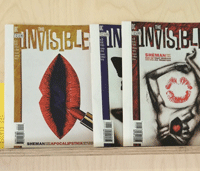
Andre Alves
Sheman
The Invisibles Volume 2, #13, #14, #15
Grant Morrison, Jill Thompson
New York City: Vertigo, 1995
A friend of mine told me “this is the weirdest shit found in comics. You see, they use this blank pin as a badge, to recognize each other.” He was talking about “The invisibles” written by Grant Morrison. I was intrigued by the blank, the all or nothing as a symbol for something. How powerful!
I grew up in a house with no books. But my brother bought comics as he progressed into his mid-teenager years. I borrowed the enthusiasm and the opportunity from him. Without knowing, he was the main responsible for the survival of an intellectual mind through comic-reading. I would tend to prefer team-based comics, specially those reflecting social injustices and the divides within the different oppressed groups. But “The invisibles” did not appear as a surrealistic oppressed group: it was something that could be felt like “us”. Us as in the “we in the now” in this apocalyptic obsessed and techno-future imaginative XXI century.
“The invisibles” felt as a revelation to a universe that would not take place with the confinement of my vocabulary, neither of the rural setting of my dwelling. There is so much richness in it. And there I found Lord Fanny, a transgender amazon sorcerer, a character in which mysticism and eroticism are expressed in similar ways. I saw myself through her; raised and living at the farm, masturbating to trees and talking to moss, living through the endless ghosts and rhythms of the apparently quiet landscape. I saw myself in Lord Fanny, in her combination of the erotic relation to the human acted through a sentiment of misanthropy (or even death) as a weird form of miraculous relief, in her relation between nature and cosmetics, in her relation between the sounds of nature and the beat of disco.
Lord Fanny works me as a protective divinity every time I see my back reflected in mirrors and the image of tattooed honeysuckle roses forms from butt-crack to neck. Or every time I step into the high heels kept in my studio, escaping the floor, shadowing the ground high as a tree.
*
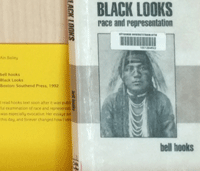
Ain Bailey
bell hooks
Black Looks
Boston: Southend Press, 1992
I read hooks text soon after it was published in 1992. It’s a coruscating and wonderful examination of race and representation, that as a fine art film student at the time, was especially evocative. Her essays on ‘Is Paris Burning?’ and ‘Madonna’ resonate to this day, and forever changed how I view these two cultural phenomena.
*
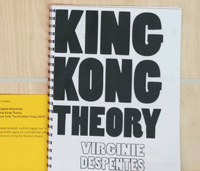
Ain Bailey
Virginie Despentes
King Kong Theory
New York: The Feminist Press, 2010
Despentes book, is a little foggier, but I recently remembered that I owned it, but can’t now find it. Again, it’s a no holds bar critique of female representation, sex, gender and more. It’s not for the feint of heart.
*
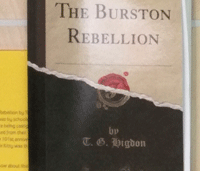
Jason Bowman
Tom Higdon
The Burston Rebellion
Hi Eva,
I have a book to bring for you. It’s The Burston Rebellion by Tom Higdon, which chronicles the longest strike in history, which was by schoolchildren who went on strike to support their leftist teachers, who were being castigated for supporting workers rights in rural Norfolk. They were evicted from their school, but a new one was built by donoations from comrades. Its the 101st anniversary of the strike this year.Higdon was the schoolmaster, and his wife Kitty was the Head of the Burston Strike school. Strangegly, or not, very few people seem to know about this.
*
Kanchan Burathoki
Jimmie Durham
An interview with a 10,000 years old artist
in: A Certain Lack of Coherence
London: Kala Press, 1993